
Historical Trauma Among Native Americans: Here’s What You Need to Know
Everyone, no matter how young or old, deals with traumas. Mental health is a serious issue that is now spoken about more than ever, yet many people still struggle to recognize its impact on their lives.
Native Americans, in turn, face an added layer of hardship rooted not only in individual experiences but in the enduring effects of historical trauma passed down through generations. Centuries of forced removals, cultural suppression, and systematic discrimination have created a collective wound that to this day influences native communities’ mental health and identity. No matter how strong a person is, trauma exposure and psychological distress endured for centuries leave an impact that can’t simply be willed away.
This is known as historical trauma, and its effects, if unaddressed, may go on and on until someone from the lineage decides to put an end to it.
Native American history is diverse and rich, and if you want to learn about it, make sure you read more on Native American Netroots. On this people search website, you might also find your relatives you didn’t know about, including those of Native American origin.
What Is Historical Trauma?
The American Psychiatric Association gives historical trauma (or intergenerational trauma) the following definition: “The transmission of trauma or its legacy, in the form of a psychological consequence of an injury or attack, poverty, and so forth, from the generation experiencing the trauma to subsequent generations.”
It develops from traumatic, life-changing events experienced by a population over a certain period of time (decades or centuries). It affects descendants even if they didn’t directly experience the original traumatic events. While it affects people of all ages, it’s not limited to a specific age; in fact, trauma can influence children, adults, and elders differently. Some effects, however, manifest more clearly at certain life stages.
According to Deconstructing Stigma, Native people experience higher levels of post-traumatic stress disorder (PTSD), suicide, and addiction in comparison to the general U.S. population. They’re also more likely to experience intergenerational poverty, which also stems from historical trauma. At 24.5%, the poverty rate for the Native American population is higher than that of any other ethnic group in the country.
As we see, historical unresolved grief experienced by people from the Native American culture is an important topic that needs to be discussed more.
Major Statistics You Probably Didn’t Know
Native American Historical Trauma: What Has This Resulted In?
Historical trauma has lasting consequences. Mental health professionals advise to address them as soon as possible, especially when they affect your life in a negative way. Unfortunately, this isn’t always possible, and many people deal with all sorts of mental health issues that continue to shape their lives and those of their children’s.
But what has historical trauma resulted in among Indigenous communities?
Violence
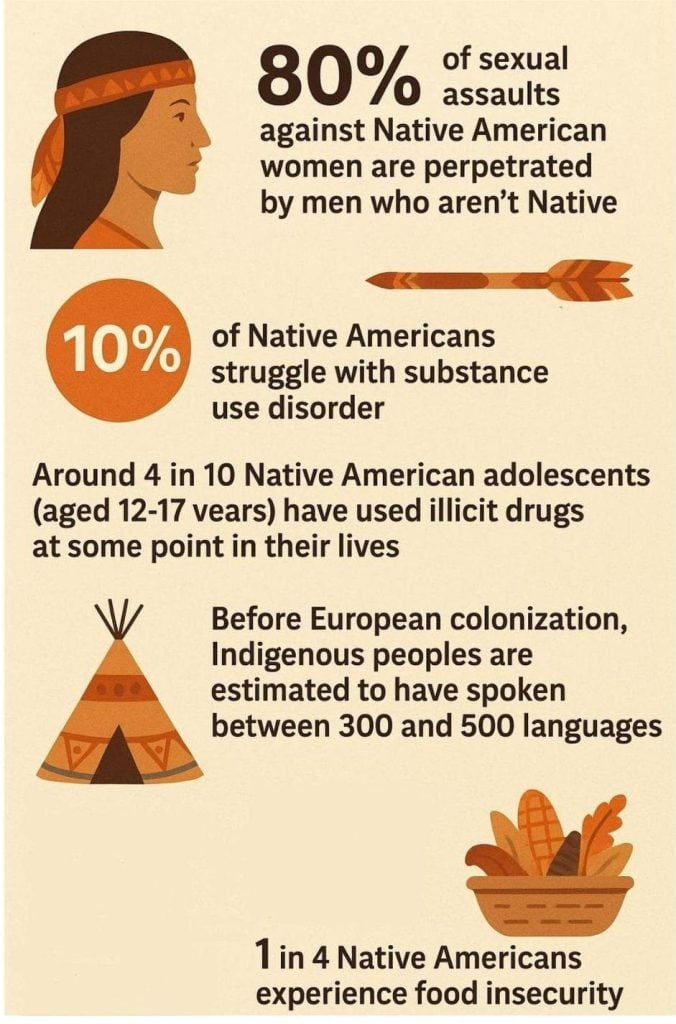
Violence, whether it’s domestic violence or other forms of abuse, is way too common and normalized in the world. Native American women, however, experience it way more than women of any other ethnic group in the country. As per Deconstructing Stigma, women of American Indian origin are almost twice as likely to experience assault or sexual violence compared to white or black women. The majority of sexual assaults against Native American women — 80%, to be precise — are perpetrated by men who aren’t Native.
According to the same source, child abuse is also widespread in American Indian communities, with 1 in 30 children being subjected to it.
But why is violence so widespread among people of this ethnicity? The thing is, colonization normalized violence against Native people, especially women. Boarding schools (where native children were forcibly sent away by the government), forced removals, and abuse created cycles of trauma that still influence communities today. Another reason, among many others, is that tribes often can’t prosecute non-Native offenders for crimes committed on reservations. And since, as we’ve already mentioned, most violent crimes against women are committed by those outside of their communities, tribal police and courts have limited legal power over them.
In 2017, according to High Country News, the U.S. Department of Justice chose not to move forward with prosecution in over one-third of the cases that were brought to them from Indian Country. Tom Udall, a Democratic politician, stated, “This report only confirms that Native victims continue to fall through the cracks of our justice system.”
Substance Use Disorders
People develop substance use disorders for a combination of biological, social, psychological, and environmental reasons. No single cause explains it for everyone; usually, it’s several factors working together.
Trauma and stress are among the most widespread reasons for substance abuse, and people who have been subjected to generational trauma are at a high risk of dealing with it.
When it comes to tribal communities, the unresolved trauma resulting from centuries of violence, forced removals, boarding school era, and cultural suppression led to depression, anxiety, PTSD, and other mental health disorders, which, in turn, led to substance abuse.
A study shows that people in Native American communities have higher overall rates of substance abuse disorders compared to the U.S. population as a whole. These rates, however, differ significantly across the many district tribes.
According to the 2018 National Survey on Drug Use and Health (NSDUH), 10% of Native Americans struggle with substance use disorder. Around 4 in 10 Native American adolescents (aged 12-17 years) have used illicit drugs at some point in their lives.
Loss of Cultural Identity
Historical trauma contributes to language loss, disconnection from traditional practices, and leads to cultural disorientation. In case with Native Americans, this has a lot to do with the removal of Native communities from their ancestral lands and native children being taken away from their families and sent to boarding schools, were they weren’t allowed to speak their Native languages. Some laws and policies prohibited many spiritual practices and rituals, so over time, younger generations of Indian people lost connection to these practices, which led to cultural disorientation.
Before European colonization, Indigenous peoples are estimated to have spoken between 300 and 500 languages. Some research also indicates that the Western Hemisphere may have had as many as 2,000 tribal languages in the 15th century. Now, Native Americans speak only around 170 languages. According to the troubling estimates, only 20 languages will survive in the next thirty years.
Today, Native American people depend largely on the federal government for education, as stated by Harvard International Review, which makes English influential for younger generations, resulting in the erosion of cultural identity.
Post-Traumatic Stress Disorder (PTSD)
The American Psychiatric Association defines PTSD as follows: “A psychiatric condition that may occur in people who have experienced or witnessed a traumatic event or series of traumatic events.”
PTSD in Native Americans often manifests similarly to PTSD in the general population, but it can also have features shaped by intergenerational trauma. Some of the examples include tribal members having recurrent thoughts related to collective historical events (forced removals, boarding school experiences) and increased aggression, irritability, or anger, among other consequences.
According to research published by Psychiatry Online, Indigenous people were two to three times as likely to develop PTSD compared to the general population in the United States.
Post-traumatic stress disorder is a serious mental health issue that affects individuals and the lives of those around them, leading to even higher levels of stress, including major depressive disorder and anxiety disorders, as well as difficulties in relationships, employment, and daily functioning.
Inadequate Healthcare
A significant factor that affects the lives of Native Peoples is inadequate healthcare. According to the Indian Health Service, American Indians born today have a life expectancy of 73.0 years, which is 5.5. years shorter than the 78.5-year life expectancy of individuals from other racial groups in the U.S.
Native Americans are affected by different chronic diseases, including heart disease, diabetes, cirrhosis, and many more which are preventable. However, many Native Americans can’t get access to proper healthcare for different reasons. The first one is underfunded healthcare systems, which leads to shortages of hospitals, medical staff, and other essential services. As per Ballard Brief, nearly all hospitals on U.S. reservations have fewer than 50 beds, with only three exceptions, and the majority don’t provide surgical or obstetric services.
The second reason is geographical barriers. Many Native Americans live in remote or rural areas, which are far from hospitals. Long travel distances make it much harder to access urgent care.
Another concern is that only 33% of the Native American population has any form of insurance (in comparison with 80% of white people and 52% of black people).
In addition, according to Ballard Brief, 1 in 4 Native Americans experience food insecurity, which leads to poor nutrition and increased risk of chronic health conditions. All these, of course, negatively impact health and overall quality of life.
Let’s Recap
American Indians and Alaska Natives represent one of the most vulnerable layers of the U.S. population. This has a lot to do with the historical trauma that was caused by the events of traumatic experiences and systematic oppression. These experiences had lasting effects on mental health, physical well-being, and social stability.
These days, the Native population of the country continues to face different challenges, including violence, substance abuse, loss of cultural identity and languages, PTSD, and poor healthcare, among other things, which makes their native heritage suffer even more significant losses.
While small steps have been taken to help the Native population, it’s still a long road ahead that requires better improvements for the first settlers of the New World.
Related Posts
-
 5 U.S. Cities with the Most Native Americans
Although American Indian and Alaska Native communities are scattered across …
5 U.S. Cities with the Most Native Americans
Although American Indian and Alaska Native communities are scattered across … -
 Native Americans During World War II: Things You Probably Didn’t Know
When the United States entered World War II, Native Americans …
Native Americans During World War II: Things You Probably Didn’t Know
When the United States entered World War II, Native Americans … -
 Myths and Misconceptions About Native Americans
Native American communities have a history that dates back thousands …
Myths and Misconceptions About Native Americans
Native American communities have a history that dates back thousands … -
 5 Famous Native American Authors
For thousands of years, Native American society relied on oral …
5 Famous Native American Authors
For thousands of years, Native American society relied on oral …