By admin

Ancient America: Stone Artifacts from the Columbia Plateau

The Maryhill Museum located near Goldendale, Washington, has a display of Plateau stone artifacts. The Plateau Culture Area is the area between the Cascade Mountains and the Rocky Mountains in Washington, Oregon, Idaho, British Columbia, and Western Montana. From north to south it runs from the Fraser River in the north to the Blue Mountains … Continued

By admin

Pat Courtney Gold’s Baskets

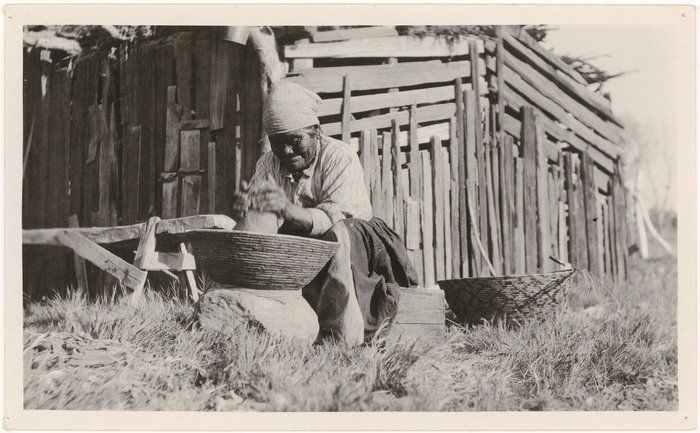
Basketry is probably the oldest art form, although the archaeological record is devoid of the earliest basketry. In his 1904 book American Indian Basketry, Otis Mason writes: “In ultimate structure, basketry is free-hand mosaic or, in the finest materials, like pen-drawings or beadwork, the surface being composed of any number of small parts—technically decussations, stitches, … Continued

By admin

Mission Indian Baskets at the Maryhill Museum

Many museums, including the Maryhill Museum of Art near Goldendale, Washington, have displays of Mission Baskets. The designation “Mission Baskets” was developed by anthropologist Alfred Kroeber in 1922. According to the Maryhill Museum display: “Basketry from most of southern California has traditionally been grouped together under the name Mission. This term was used because the … Continued

By admin

Ancient America: Carved Stone Figures in the Plateau

The Maryhill Museum located near Goldendale, Washington, has a display of Plateau stone artifacts. The Plateau Culture Area is the area between the Cascade Mountains and the Rocky Mountains in Washington, Oregon, Idaho, British Columbia, and Western Montana. From north to south it runs from the Fraser River in the north to the Blue Mountains … Continued

By admin

Northwest Coast Masks

The Northwest Coast culture area stretches along the Pacific coast between the Cascade Mountains and the ocean. It extends north of California to Alaska. This is an area which is the home to many Indian nations who traditionally based their economy on the use of sea coast and river ecological resources. The Northwest Coast culture … Continued

By admin

Ancient America: Mesoamerican Stelae

Mesoamerica is the area from Mexico south through Panama. In this geographic area, a number of complex cultures emerged with subsistence patterns based on agriculture and wide-spreading trading networks. Like the ancient civilizations in other parts of the world, such as Mesopotamia, China, and Egypt, the Mesoamerican civilizations were characterized by cities, hierarchical governments, and … Continued

By admin

The Sioux in Canada

Following the 1876 Battle of the Little Bighorn in which the American 7th Cavalry under the command of Lt. Col. George Custer attacked a peaceful camp of Sioux, Northern Cheyenne, and Arapaho Indians which resulted in the massacre of the American troops, some of the Sioux bands fled north, seeking political asylum in Canada. Seeking … Continued

By admin

The Northern Pacific Railroad and the Sioux

Almost since the foundation of the United States, the westward expansion of the country was guided by Manifest Destiny, the idea that it was the country’s destiny to span the continent from the Atlantic to the Pacific. By the middle of the nineteenth century, it was clearly evident that the way of westward expansion would … Continued

By admin

A Very Short Overview of the Caddo Indians

The traditional homelands of the Caddo stretched from the Red River Valley in Louisiana to the Brazos River Valley in Texas. The Caddo were agricultural people whose culture emerged about 800 CE. Caddo culture is considered to be related to the Mississippian mound-building cultures. The term “Caddo” originates from one particular tribe, the Kadohadacho who … Continued

By admin

America’s Christian General and the Nez Perce

As a Christian nation, the United States has never been comfortable with the idea that American Indians might have their own non-Christian religions or that Indian spiritual leaders could provide role-models for other Indians. Under the European notion of the Discovery Doctrine, the United States felt that it had a legal right to rule over … Continued